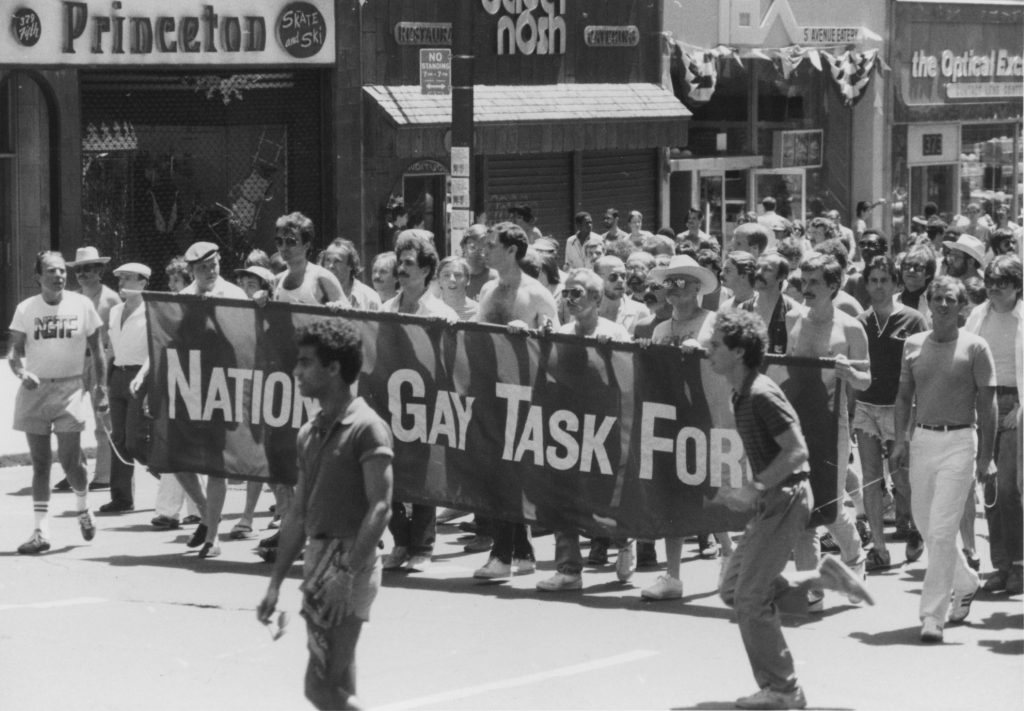
Task Force History
An uncompromising voice for equality for more than three decades...
“No account of the changes in laws and public policies would be complete without attention to [the Task Force's history]. The Task Force played a critical role in the campaign to eliminate the sickness classification of homosexuality. It worked to lift the prohibition on federal civil service employment for gays and lesbians. It strove in the 1970s to make the Democratic Party responsive to the gay community. It took the lead in the 1980s in national organizing against homophobic violence. As AIDS began to devastate gay male communities, the Task Force shaped the first serious efforts in Washington to address the epidemic. It was a founding member of the Military Freedom Project, which prepared the ground for the gays-in-the-military debate of 1993. It has worked with the administrations of presidents from Carter to Clinton.” — From John D'Emilio's Interpreting the NGLTF Story
2006
December 26, 2006 – The Task Force mourns the death of former President Gerald R. Ford, who died at the age of 93. “Because he espoused true conservative values, he consistently advocated for the rights of individuals and condemned those who sought to impose conformity of thought and behavior,” said Executive Director Matt Foreman. “These beliefs led him to support women’s rights and to publicly support federal legislation to prohibit anti-gay discrimination in employment. When, in 2001, he said, ‘I think they [same-sex couples] should be treated equally. Period,’ he became the highest-ranking Republican ever to publicly support equal treatment for our families.”
December 14, 2006 – At New York City Hall, the Policy Institute releases the report Lesbian, gay, bisexual and transgender youth: An epidemic of homelessness in collaboration with the National Coalition for the Homeless. The study revealed an epidemic of homelessness among lesbian, gay, bisexual and transgender (LGBT) youth. According to statistics cited by the federally funded National Runaway Switchboard, up to 42 percent of homeless youth identify as gay or lesbian, which is grossly disproportionate given that approximately 3 to 5 percent of the U.S. population identifies as gay or lesbian.
December 14, 2006 – The Task Force hails passage of New Jersey bill prohibiting discrimination based on gender identity and expression. With governor's signature, New Jersey became the 9th state with clear and strong transgender protections. With New Jersey’s new law, 34 percent of the nation's population will live in a jurisdiction with a clearly transgender-inclusive nondiscrimination law, up from just 6 percent only five years ago. Babs Casbar, political director of the Gender Rights Advocacy Association of New Jersey (GRAANJ) said, “The Task Force and the legislative lawyer in its Transgender Civil Rights Project, Lisa Mottet, have been instrumental partners in the success of the transgender nondiscrimination legislation from its genesis in 2004. They worked with our allies and prime sponsor to craft a strong bill; provided educational tools to promote the legislation; advised us on several eleventh-hour amendments; and gave us financial support at a crucial moment.”
December 5, 2006 – The Policy Institute releases a study that reveals that bans on same-sex marriage performed more poorly in the November 2006 elections than in the past, in part due to their declining appeal in states with smaller “born-again” Christian populations. The study, Same-sex marriage initiatives and lesbian, gay and bisexual voters in the 2006 election, finds that if current trends hold, such bans would fail at the ballot box in many of the states that have not yet considered same-sex marriage initiatives.
December 1, 2006 – On this World AIDS Day, the Task Force calls for greater federal response to HIV/AIDS epidemic and urges an aggressive response by the federal government to fight the disease, saying “anything less is not only unacceptable, it is immoral.”
November 20, 2006 – The Task Force commemorates the International Transgender Day of Remembrance by reflecting on the loss of members of the transgender community due to hate or prejudice. “We pledge to our transgender brothers and sisters that we will not allow a federal nondiscrimination or hate crimes bill to move forward that does not include you. You are us and we will not walk down the path to equality without you at our side,” said Executive Director Matt Foreman.
November 10, 2006 – The Task Force, in partnership with Ipas and the SisterSong Women of Color Reproductive Health Collective, releases an updated Mapping Our Rights: Navigating Discrimination against Women, Men and Families, an easy-to-use innovative interactive map — with state-by-state rankings — including information on the 32 new bills restricting sexual and reproductive rights passed in state houses around the country in the last six months.
November 8, 2006 – With an increased focus on racial and economic justice issues, the 19th Annual Creating Change Conference opens in Kansas City, Mo., where more than 2,000 LGBT leaders and activists set the agenda for upcoming battles. Matt Foreman delivered his State of the Movement address to a packed room.
November 7, 2006 – The Task Force releases a complete analysis of election results the same night of the midterm election. For the first time, a proposed constitutional amendment to ban any form of legal recognition for same-sex couples was defeated, and 37 percent of voters opposed the various bans, a significant increase over the 31 percent who opposed similar ballot measures prior to 2004. As important, election results in House, Senate and gubernatorial races coast to coast show that supporting fairness for LGBT families is not a liability, while aligning with the extreme Christian right is. Also, as a resource for reporters, researchers and activists, the Policy Institute provided a detailed table of information for every anti-same-sex marriage ballot measure from 1998 through the 2006 midterm election.
November 6, 2006 – Former President Bill Clinton makes a surprise appearance at Saturday’s 10th Annual Miami Recognition Dinner, a benefit for the Task Force, where he wowed the 650-plus-crowd. Clinton, who was in South Florida to campaign for Democratic candidates, arrived at the event around 8 p.m., where he greets NAACP Chairman Julian Bond, one of the evening’s honorees, and then shakes hands with numerous attendees.
October 27, 2006 – The Policy Institute releases the report titled Homophobia at ‘Hell House’: Literally Demonizing Lesbian, Gay, Bisexual and Transgender Youth, which estimates that this Halloween season, 1.6 million people, many of them children as young as 10 years old, will go to “Hell Houses,” religious alternatives to traditional haunted houses that are designed to scare youth into a “sin-free life.”
October 24, 2006 – The Final Report of the 2005 White House Conference on Aging (WHCoA), released by the Administration on Aging, marks a milestone in the fight for the rights of LGBT elders. Months of intensive organizing, including nationwide town hall meetings and the Task Force-convened “Make Room for All” diversity summit in December 2005 — a counterpoint to the WHCoA — have paid off in the explicit inclusion of LGBT elders in the report.
October 18, 2006 – The National Gay and Lesbian Task Force, Inc., and 17 LGBT coalition partners launch Phone Home 2006, a unique campaign to reach voters in states facing anti-gay ballot initiatives this November. The Phone Home 2006 campaign asked people to contact the folks back home to ask them to vote against discrimination. The campaign was targeted at voters in Arizona, Colorado, Idaho, South Carolina, South Dakota, Tennessee, Virginia and Wisconsin, states facing discriminatory ballot initiatives.
October 8, 2006 – The Task Force honored leaders and allies who have given significant support to the fight for equality for lesbian, gay, bisexual and transgender (LGBT) people at the Annual Los Angeles Leadership Awards. Acknowledging the critical role that California continues to play on the road toward achieving full equality for LGBT people, the Task Force honors Alice Huffman is recognized for her role in garnering support from the California State Conference of the NAACP and its allies in pursuit of marriage equality; Sen. Barbara Boxer for her support for LGBT-inclusive hate-crimes legislation and opposition to same-sex marriage prohibitions at the federal level; and Richard Glatzer and Wash Westmoreland, co-directors of Quinceañera, for their important contributions on the cultural front.
September 28, 2006 – At a Commonwealth Club panel titled Values — yes, but whose values?, Task Force Executive Director Matt Foreman and Bishop Yvette Flunder discussed the reclaiming of the moral values discourse. Foreman and Flunder expanded the conversation about values and made the case for how and why it is important to take back the values debate.
August 30, 2006 – The Task Force releases the results of its survey of the policy concerns of 1,440 attendees of LGBT pride celebrations. The survey, conducted in six cities during pride season 2006, listed 10 policy priorities for the LGBT community and provided a space to write in more, asking participants to circle three. The 10 priorities were immigration, anti-LGBT discrimination, hate violence/harassment, marriage equality/partner recognition, media representations, HIV/AIDS, same-sex domestic violence, health issues, elder issues and youth and education issues.
August 20, 2006 – More than 1,800 people attend Ascension, the first daytime dance party on the Fire Island Pines beach in nearly a decade. Ascension was organized by Eric von Kuersteiner, a community leader in the Pines, and half of the proceeds benefited the Task Force. The premiere event’s success ensures it will become a long-running tradition.
August 16, 2006 – A conservative political group asks the Cincinnati Board of Elections to remove its anti-LGBT referendum from the November ballot, an acknowledgment of fraud in its signature gathering and the likelihood of defeat at the polls. As a result, LGBT people will be protected from discrimination for the first time since 1992.The Task Force invested heavily in the Citizens to Restore Fairness campaign that was geared up to defeat the initiative, including early financial support and the deployment of three full-time staff, three summer organizing fellows and a campaign consultant.
July 25, 2006 – The Task Force leads a coalition of more than 60 civic, religious, labor and civil rights leaders and organizations declaring their commitment to working toward equality for gay and lesbian families in full-page newspaper advertisements appearing coast to coast. The ads, titled "Marriage Matters," appeared in 50 publications, including the New York Times, the Fresno Bee (Calif.), the Cedar Rapids Gazette (Iowa), the Raleigh News & Observer (N.C.), the Capital Gazette (Md.), the Cook County Daily Herald (Ill.) and La Opinion (Calif.). The ads feature photographs of five same-sex couples who have been together from five to 53 years and read, on behalf of the diverse signatories, "They're committed. So are we."
June 26, 2006 – The Task Force mourns the death of Eric Rofes, a leader, activist, visionary, former board member and dear friend to the Task Force. “Eric Rofes was one of the most extraordinary voices in our community. He spoke — and suffused others — with the joy of being who we are. His leadership in the communities where he lived, and in the national community, contributed enormously to our understanding of the need for honest discussions about the LGBT community and its issues. Eric’s death is a loss to all of us, of a rare voice of truth,” said Task Force board member Loren Ostrow, co-chair of the Los Angeles Gay and Lesbian Center. In his memory, the Eric Rofes Memorial Scholarship Fund was established in honor of one our movement’s most visionary leaders. The fund will provide scholarships to young activists who wish to attend Creating Change, the nation’s premier LGBT organizing conference.
June 16, 2006 – The Task Force launches the largest-ever study of lesbian, gay, bisexual and transgender (LGBT) Asian and Pacific Islander (API) Americans. The study, will be conducted by the Task Force Policy Institute in collaboration with API organizations in Boston, Chicago, Los Angeles, New York, San Francisco, Seattle and Washington D.C., and will seek at least 500 participants to complete an online survey. The study will be released in spring 2007.
May 31, 2006 – The Task Force, in collaboration with Ipas, an international reproductive health organization based in Chapel Hill, N.C; and the SisterSong Women of Color Reproductive Health Collective, launches Mapping Our Rights: Navigating Discrimination Against Women, Men and Families, a new interactive Web site that scores the states and Washington, D.C., on their legislation regarding sexual and reproductive rights.
May 22, 2006 – In a commentary titled Si Se Puede!, Executive Director Matt Foreman says that immigration is and needs to be a gay issue. “There are many aspects of immigration that are undeniably “gay,” such as the reality that at least 500,000 of the estimated 12 million undocumented persons now in this country are lesbian, gay, bisexual or transgender. But we support humane immigration reform regardless of our issues. We must build alliances and relationships of trust with other communities and causes. Building these kinds of alliances requires more than words, it requires reciprocal work. Can we take a stand? Si se puede!”
May 6, 2006 – The Task Force’s D.C. Leadership Awards, honoring U.S. Sen. Russ Feingold (D-Wis.), U.S. Rep. John Conyers Jr. (D-Mich.), Pulitzer Prize winner and Brokeback Mountain author Annie Proulx, and Food & Friends, an organization that provides critical support to people facing life-challenging illnesses, drew a 450-plus crowd. The event — the first full-fledged dinner the Task Force has done in D.C. in 13 years — raised nearly $200,000.
April 20, 2006 – More than 320 turn out for the New York Leadership Awards honoring New York City Council Speaker Christine Quinn, one of the most powerful openly lesbian or gay elected officials in the nation, and Pulitzer Prize-winning author Michael Cunningham. The event, held at the Grand Hyatt Hotel in midtown Manhattan, was the Task Force’s first full fund-raising dinner in New York in 16 years and raised over $200,000.
April 4, 2006 – The Policy Institute releases a report that exposes the dishonesty of attempts by leaders of the Republican Party to lure black voters based on 'moral values' and spotlights the false promises inherent in Republican National Committee Chairman Ken Mehlman's call for African-Americans to come "back home" to the GOP. The report, False Promises: How the Right Deploys Homophobia to Win Support from African-Americans, compares the voting records of key Republican policymakers in Congress to polling of African-Americans' top voting priorities and finds that Republican lawmakers have abysmal voting records on these issues. The report shows that legislators with low ratings on LGBT equality also receive low ratings from organizations that promote the rights of people of color, including the NAACP and the Leadership Conference on Civil Rights.
March 13, 2006 – The Task Force announces that the Institute for Welcoming Resources (IWR), an umbrella organization for leading Protestant LGBT welcoming church programs, is merging with and becoming a program of the Task Force. The move, an unprecedented joining of LGBT secular and faith-based organizing, provides new resources, training and strategies that will increase the number of people of faith supporting equality for LGBT people.
March 5, 2006 – A record-breaking crowd of 5,400 danced to the music of Phil B. and enjoyed live performances by Kim English and Jason Walker at the Winter Party Festival, the annual Beach party on the sands of South Beach. The Task Force continued to make strides in its plans to evolve Winter Party into a festival offering events that appeal to all segments of our community. Two-thirds of the festival proceeds were donated by the Task Force for distribution lo local organizations serving the LGBT community through the Dade community foundation.
March 2, 2006 – The Policy Institute releases a report that reveals the ex-gay movement's new tactic of targeting lesbian, gay and bisexual youth for "conversion-therapy" and "preventive" measures. The report, Youth in the Crosshairs: The Third Wave of Ex-Gay Activism, reveals how groups such as Exodus International and Focus on the Family promote widely discredited theories on the root of homosexuality and now recommend "prevention" and conversion therapy treatments despite the growing body of research that shows these treatments to be ineffective and even harmful for many participants.
January 31, 2006 – The Task Force mourns the death of Coretta Scott King, widow of civil rights leader Martin Luther King Jr., who died at the age of 78. Mrs. King worked tirelessly after her husband’s death in 1968 to carry on his legacy of social justice activism. She was a steadfast ally in the struggle for LGBT rights, and was honored by the Task Force in 1997 for her support of the cause. Matt Foreman was one of five LGBT community representatives at Mrs. King’s funeral near Atlanta.
January 31, 2006 – The Task Force National Religious Leadership Roundtable releases a groundbreaking study on the resources, challenges and opposition to LGBT-affirming religious organizations. The study, David v. Goliath: A Report on Faith Groups Working for Lesbian, Gay, Bisexual and Transgender Equality (and What They're Up Against), includes large denominations and independent congregations.
January 10, 2006 – The Task Force Foundation announces that it has been awarded a combined gift of $3 million over three years from the Arcus Foundation and its founder and president, Jon Stryker, to support its nationwide campaign of organizing, capacity building, advocacy and public education to advance equal rights and respect for LGBT people.
2005
March 17, 2005 – Following the murder of Washington, D.C., LGBT leader Wanda Alston, the Task Force contributes $10,000 to the reward offered for information leading to the identity of her slayer.
March 16, 2005 – The Policy Institute commemorates Women's History Month with a report on same-sex households headed by LBT women of color. This demographic is likely to raise foster or adopted children, but earn considerably less when compared to married, opposite-sex black and Hispanic/Latino households. Data are taken from three reports published by the National Gay and Lesbian Task Force Policy Institute during the last year: Black Same-Sex Households in the United States: A Report from the 2000 Census, Hispanic and Latino Same-Sex Households in Florida: A Report from the 2000 Census and Asian Pacific American Lesbian, Gay, Bisexual and Transgender People: A Community Portrait.
March 2, 2005 – The Task Force congratulates the LGBT community and allies of Topeka, Kan., for narrowly defeating an ordinance that would have limited laws protecting LGBT Kansans from discrimination for the next 10 years. It would have also repealed existing city ordinances banning LGBT discrimination. The Task Force was a driving force behind the "Vote NO on March 1st" campaign; it recruited and paid for campaign staff, provided technical assistance, contributed approximately $20,000 in cash, and organized volunteer phone banks in New York; Kentucky; Washington, D.C.; and Tacoma, Wash., to call undecided voters. The vote against the ordinance was 52 percent to 48 percent (with 95 percent of the precincts reporting).
(L-R) Kansas ACLU cooperating attorney Pedro Irigonegaray, Sarah Swartz and Task Force Executive Director Matt Foreman celebrating the March 1, 2005, defeat by Topeka voters of a Fred Phelps anti-LGBT ballot initiative.
March 1, 2005 – The Policy Institute releases its first-ever study of Hispanic and Latino same-sex households. An analysis of the results of the 2000 Florida census, the report confirmed that Hispanic same-sex households bear resemblances to heterosexual households in parenting, military participation and disadvantages in income and home ownership. Hispanic/Latino same-sex couples have more to gain from the legal protections of marriage, and more to lose if the state passes the proposed amendment banning same-sex marriage and other forms of partner recognition.
February 25, 2005 – The Task Force creates a new department of Public Policy & Government Affairs and hires three noted leaders and advocates — including former U.S. Assistant Attorney General Eleanor D. (Eldie) Acheson — to staff the department. Created to strengthen the Task Force's voice in federal matters, the new department focuses on LGBT community health and human service needs and legislation to address inequities in all phases of everyday life. Joining Acheson are Dave Noble, former executive director of National Stonewall Democrats and Amber Hollibaugh, a leading expert on LGBT senior issues and HIV in women, most recently from SAGE (Services and Advocacy for LGBT Seniors).
February 15, 2005 – The Policy Institute releases a landmark study on black same-sex households in major American cities, confirming that such same-sex households are almost as likely as black married opposite-sex couple households to include children and more likely to report serving in the military; that Black same-sex couples are more likely to work in the public sector, and that they earn less than married black couples. Same-sex couples surveyed reside in San Francisco, Los Angeles, Detroit, Chicago and Philadelphia. The five-city analysis is a supplement to the groundbreaking study, Black Same-Sex Households in the United States: a Report from the 2000 Census, released in October by the Task Force Policy Institute and the National Black Coalition.
February 8, 2005 – The Policy Institute issues a groundbreaking report titled Asian Pacific American Lesbian, Gay, Bisexual & Transgender People: a Community Portrait. The analysis confirms that 82 percent of Asian Pacific American LGBT people surveyed had experienced discrimination based on their sexual orientation, and the same percentage had experienced discrimination based on their race or ethnicity. Future studies will study APA LGBT people in U.S. cities with large APA populations, including Los Angeles and San Francisco.
February 4, 2005 – Matt Foreman hails a court opinion by New York City Justice Doris Ling-Cohan, determining that LGBT people should have equal access to marriage.
January 25, 2005 – The Policy Institute issues a report titled Glass Half Full, which chronicles the advance of U.S. laws banning discrimination based on sexual orientation. Currently, 47 percent of all Americans — 138 million people — now live in a jurisdiction that bans discrimination on the basis of sexual orientation. Ten years ago, the figure was 34 percent.
January 12, 2005 – The Policy Institute releases a report on anti-gay marriage measures in the 2004 elections. Titled Impact of Voting against Anti-gay Marriage Amendments on 2004 Re-election Campaigns in Five Midwestern States, it determines that incumbents were not harmed when they voted against anti-gay proposals to amend state constitutions. Among the findings: In Iowa, all 7 legislators who voted against the anti-gay amendment were re-elected, compared to 71 percent (10 of 14) of those who voted for it. In Minnesota, 98 percent (40 of 41) of House members who voted against the anti-gay amendment were re-elected, compared to 86 percent of those who voted for it. There were no Republican legislators in five states surveyed who benefited electorally from supporting anti-gay amendments.
January 20, 2005 – Matt Foreman denounces President Bush's second inaugural speech, suggesting that Bush's rhetoric about equal rights and dignity for all runs counter to his ongoing attacks on the rights of LGBT people. "President Bush focused much of his second inaugural address on spreading 'the force of human freedom' across the world. Here at home, over the past four years this administration and its allies have attacked the rights and dignity of lesbian, gay, bisexual and transgender Americans. In his second term, we challenge the president to be true to his words and begin proclaiming — instead of attacking — the rights, dignity, and matchless value of gay Americans."
2004
December 20, 2004 – The Task Force salutes the fifth anniversary of same-sex civil unions in Vermont. Matt Foreman points out that more than 60 percent of Americans support civil unions or civil marriage for same-sex couples.
December 10, 2004 – The Task Force joins leading LGBT organizations in sending a letter to all members of Congress, denying that community groups will pull back from same-sex marriage or work with the Bush administration to privatize Social Security in exchange for support, as erroneously reported in a Dec. 9 New York Times article. "Where We Stand: A Letter to all Members of Congress" sets off a series of articles in major U.S. media, including the New York Times, Washington Post and Boston Globe.
A feature story on "Gaymerica," the Task Force's online voter education campaign satirizing the way in which the right seeks to exploit irrational fears about gay people to divide the nation.
December 9, 2004 – In an interview with the New York Times, Matt Foreman explains the reason for the passage of 11 state amendments banning same-sex marriage. Foreman states: "Putting a fundamental right up for a popular vote is always extremely difficult to win, no matter what the cause. And when you are talking about something as recent as marriage equality, the bar gets raised even higher." Foreman adds that anti-LGBT backlashes have occurred in the past, following progress in the movement. But he pledged that the Task Force would remain on the offensive. "A lot of gay people understand the concept of bullies," Foreman said. "The worst thing you can do with a bully is not fight back because you'll only get hit harder the next day."
December 3, 2004 – The Task Force Religious Leadership Roundtable condemns CBS and NBC for refusing to run a television ad by the United Church of Christ, which promotes their policy of inclusiveness to all, and includes same-sex couples.
November 11, 2004 – The first post-election LGBT conference, the 17th Annual Creating Change Conference, opens in St. Louis and draws 2,500 people. Community's leaders regroup to assess the reasons for an overwhelming passage of anti-gay legislation in 11 states one week earlier.
November 4, 2004 – Matt Foreman calls a press conference to dispute a growing post-election myth that same-sex marriage was the reason for George Bush's re-election. Foreman states: "Frankly, the right did a better job in turning out their vote in key places. They've been building their machine — illegally, unethically, or both — through churches for 30 years. They have seized and occupied "moral values" for years. Our side is not going to make up these deficiencies in one cycle. But to pin all of this on "the gays" is wrong. Don't buy it."
November 3, 2004 – In national elections, anti-gay marriage amendments pass in 11 states, with budgets by pro-discrimination groups dwarfing the spending of local pro-equality activists.
November 1, 2004 – The Policy Institute issues a report titled Couples Affected By 2004 Anti-Gay Ballot Initiatives. The analysis concludes that upcoming discriminatory marriage amendments would affect more than 500,000 same- and opposite-sex couples in Kentucky, Ohio and Georgia alone.
October 19, 2004 – New York City goes to court to fight implementation of the Equal Benefits Law, which would prevent business with vendors who practice anti-gay discrimination. Condemning the mayor's action, Matt Foreman resigns his position on New York City's Human Rights Commission.
October 15, 2004 – Matt Foreman dismisses the notion that John Kerry unfairly referred to Mary Cheney's lesbianism during the presidential debates. He urges media to focus on critical issues, stating, "Can we talk about something real, not the patently bogus hurt and anger of Dick and Lynne Cheney?"
October 8, 2004 – Matt Foreman issues a rallying cry to all LGBT people to defeat the state-by-state constitutional amendments in the coming election through increased community organizing and voter registration. Foreman declares, "We need to face the obvious: we are huge underdogs in every one of these battles. Not because marriage equality is simply a losing issue. It is not. Not because we don't have talented and courageous leaders and organizations on our side throughout this country. We do. Instead, it's because — with only a handful of exceptions — our side simply does not have the time, the resources, or the infrastructure to beat back the forces being unleashed against us in this election year."
October 6, 2004 – The Policy Institute and the National Black Justice Coalition release a joint report titled Black Same-Sex Households in the United States: A Report from the 2000 Census. The analysis confirms disproportional economic and social burdens faced by black same-sex households. These burdens include lack of access to state/federal aid programs designed only to aid married families. Black same-sex couples comprise 14 percent of all U.S. same-sex couples.
September 24, 2004 – The Task Force unveils its satirical "United States of Gaymerica" online campaign designed to ridicule the hate rhetoric of anti-LGBT groups. Three short films reaffirm the ridiculousness of right-wing claims against same-sex marriage, including one which calls for the farcical "Bovine Love Amendment."
August 8, 2004 – The Task Force assumes responsibility for organizing the famed Winter Party and Recognition Dinner, both significant fundraisers for Miami-Dade's LGBT community.
August 3, 2004 – Matt Foreman issues a statement demanding inclusion of transgender rights in the wording of the Employment Non-Discrimination Act (ENDA).
July 7, 2004 – The Task Force, working with SAVE Dade, help pass legislation in Miami Beach City to include non-gender-specific language in its anti-discrimination policies. This provides protection for transgender people who are legally overlooked because they do not fit traditional gender stereotypes.
New York City Councilmember Margarita Lopez celebrating the defeat of anti-sodomy laws by the U.S. Supreme Court at a Task Force-sponsored rally at Stonewall Place in Manhattan on June 26, 2004.
June 17, 2004 – The Policy Institute releases a study titled Caregiving Among Lesbian, Gay, Bisexual and Transgender New Yorkers. It confirms that LGBT New Yorkers are often required to become caretakers of aging family members, thus debunking the right-wing's "anti-family" message concerning lesbian and gay people.
June 6, 2004 – In response to national mourning over the death of former President Ronald Reagan, Matt Foreman releases an open letter, addressed to a close friend and colleague who died of AIDS. Foreman cites Reagan's inaction during the early days of the epidemic, which led to tens of thousands of deaths. The letter receives much attention in the press.
May 28, 2004 – The Policy Institute and the Woodhull Freedom Foundation launch a study of sex laws still on the books across the United States to help focus grassroots actions to change these laws, many drafted specifically against the LGBT community.
May 17, 2004 – Matt Foreman highlights the hypocrisy of President Bush in commemorating the 50th anniversary of the Brown v. Board of Education decision while simultaneously calling for renewed support for the discriminatory, anti-gay Federal Marriage Amendment.
May 17, 2004 – As Massachusetts begins its first day of legally marrying same-sex couples, The Task Force issues a congratulatory statement. "This wonderful day would never have happened but for the more than four decades of struggle for equal rights by lesbian, gay, bisexual and transgender people all across our nation. Day after day, year after year, we have opened hearts and changed minds." Sue Hyde, director of the Creating Change Conference, is among the first to wed.
May 14, 2004 – In a meeting between leading Senate Democrats and leaders of the LGBT community, including the Task Force's Matt Foreman, senators reaffirm the party's commitment to defeating any amendment to the constitution prohibiting same-sex marriage.
May 4, 2004 – Matt Foreman releases a statement chastising Democratic politicians for their modest mobilization against the Federal Marriage Amendment. Foreman states: "The religious right knows how to play adult politics: they insist on getting something in exchange for their support. It's time we did the same. Our community is owed a renewed pledge [from Democrats] — now — that any anti-marriage amendment is dead on arrival in the Senate."
Task Force Deputy Executive Director Rea Carey speaking via video at the March for Women's Lives, the largest-ever protest march in the nation's capital, on April 25, 2004.
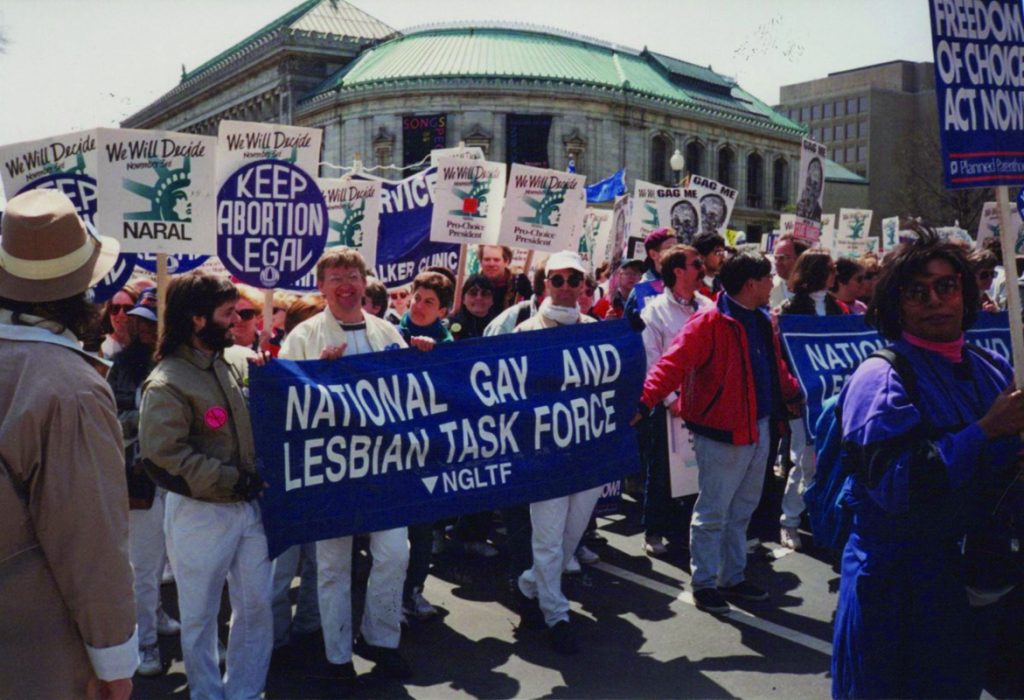
(L-R) Sarah Reece, Development Database Administrator Henry Woodside, Executive Director Matt Foreman and Candy Cox carrying the Task Force banner at the March for Women's Lives in Washington on April 25, 2004.
April 26, 2004 – The Task Force brings LGBT activists to the D.C.-based March for Women's Lives, emphasizing the strong tie between reproductive rights and equal rights. From the pre-march rally speakers stage, Task Force Deputy Executive Director Rea Carey declares a common agenda: "Our legal legacies depend on each other. We will march today because the enemies of reproductive freedom are the same enemies of equal rights for lesbian, gay, bisexual and transgender people."
April 23, 2004 – The Task Force will join the upcoming March for Women's Lives in support of reproductive health and reproductive freedom. Matt Foreman urges LGBT community presence.
April 5-13, 2004 – The Policy Institute issues two reports analyzing the disproportionate financial burden on same-sex couples in both Massachusetts and Oregon. The reports are titled Economic Benefits of Marriage Under Federal and Massachusetts/Oregon Law. These studies confirm the lack of legal support for same-sex couples, as they are exempt from numerous federal and state tax advantages enjoyed by heterosexual couples.
April 1, 2004 – The Task Force announces that it will receive 10 percent of sales of the reissued book, Sisters, a lesbian-themed western written by Vice President Dick Cheney's wife Lynn in 1981. The donations will be made by Left Bank Books of St. Louis, Mo. (The Cheneys' daughter Mary is an out lesbian with a partner, while her father supports an anti-gay marriage amendment to the Constitution.) Shortly after this fundraising offer is announced, Penguin Books chooses not to re-issue the book.
March 26, 2004 – The Task Force opens its Power Summit in Boston to prepare local activists for the upcoming Massachusetts constitutional battle over same-sexmarriage. Over four days of workshops, attendees learn grassroots campaigning, legislative action and door-to-door canvassing techniques. Guest speakers include Matt Foreman, Rea Carey and openly gay Congressman Barney Frank (D-Mass).
U.S. Rep. Barney Frank speaking with Sarah Hamlen and Linda Blair, participants in the Task Force's March 2004 Power Summit.
Playwright Tony Kushner presenting the Leadership Award to Gene Robinson on March 15, 2004.
March 15, 2004 – V. Gene Robinson, the first openly gay Bishop in the Anglican Communion, is honored by the Task Force at its 15th Annual New York City Leadership Awards.
March 11, 2004 – The Policy Institute issues a report about the self-titled "pro-family" groups fighting against same-sex marriage in Massachusetts. Titled Anti-Gay Groups Active in Massachusetts: A Closer Look, it identifies their true homophobic agenda. Local media outlets are urged to investigate these groups' true motives and sources of income.
Executive Director Matt Foreman at the New York rally protesting President Bush's call for a constitutional amendment banning same-sex marriage on Feb. 24, 2004.
March 5, 2004 – The Task Force commends the efforts of local activists in Maine, Indiana and Wyoming in preventing the local passage of legislation outlawing same-sex marriage.
February 24, 2004 – President Bush calls for Congress to pass an anti-marriage amendment directed specifically at same-sex couples. Matt Foreman calls the action "a despicable new low." He adds, "The president's exhortation that this debate be conducted 'without bitterness or anger' is an insult to our families, our dignity and to our contributions as citizens to the life of this nation. We consider today's announcement a declaration of war on gay America."
February 24, 2004 – The Task Force organizes protest rallies in New York, Los Angeles and San Francisco in immediate response to President Bush's election-year call for Congress to pass an anti-gay marriage amendment.
January 14, 2004 – Responding to President Bush's plans for a $1.5 billion proposal to 'sustain marriage,' Matt Foreman warns that Bush's emphasis on same-sex marriage will really serve as a dividing wedge in the upcoming election year between two heavily Democratic bases, African-Americans and lesbian and gay people. Foreman states, "Struggling [African-American] families do not need $1.5 billion worth of marriage counseling. More importantly, they need jobs, health coverage, and decent schools for their children."
February 1, 2004 – The Task Force co-sponsors the first LGBT Asian Pacific Americans Conference, to be held in New York City in March. Its objective is raising the consciousness of one of the fastest growing minorities in the U.S. The conference will address invisibility, isolation and stereotyping, and the need to incorporate LGBT identity with sexual, racial/ethnic, language, gender, immigrant, and economic diversity within their own community.
2003
December 18, 2003 – The Task Force renews its "Bring it home for the Holidays" campaign for Christmas, urging LGBT people and their allies to solicit support from family and friends against President Bush's anti-gay agenda.
December 16, 2003 – President Bush confirms on national television he will actively campaign to write anti-gay discrimination into the U.S. Constitution. The Task Force calls on all members to telephone the White House in protest. Matt Foreman responds: "We consider this a declaration of war on lesbian, gay, bisexual and transgender America. The president is clearly using our lives and families to pander to the political and religious extremists that comprise his base. We did not ask for this fight, but if the president wants one, he will have one."
November 24, 2003 – The Task Force issues a holiday appeal called "Talk Turkey: Bring it Home for the Holidays," asking LGBT people and their allies to explain to family members during Thanksgiving the damage to their lives caused by the president's anti-gay amendment campaign.
November 18, 2003 – In a historic decision, the Massachusetts High Court affirms that denying same-sex couples the right to marriage is an affront to their civil liberties and therefore specifically outlawed in the state constitution. The court demands a 180-day grace period before the decision takes effect, allowing the state Legislature to enact "appropriate action." Matt Foreman hails the decision as "an exhilarating victory, an important battle won in the struggle for equal rights."
November 17, 2003 – The Policy Institute releases a study on LGBT students and the children of LGBT parents titled Education Policy: Issues Affecting Lesbian, Gay, Bisexual and Transgender Youth. While violence and harassment against this group is widespread, more states are taking steps to make schools safer for them by banning student discrimination based on gender identity. The report makes a series of recommendations involving sex education and after-school programs to give LGBT youth a greater degree of acceptance.
November 7-16, 2003 – The 16th annual Creating Change Conference, sponsored by the Task Force, takes place in Miami and attracts 2,000 attendees from across the country. The themse is "Building an Anti-Racist Movement for Social and Economic Justice."
Celebrating the passage of domestic partnership registries on Nov. 4, 2003, in Cleveland Heights, Ohio (L-R): Heights Families for Equality leader David Caldwell, Task Force Organizing & Training Director Dave Fleischer and Field Organizer Jason Cooper.
November 4, 2003 – In Cleveland Heights, Ohio, voters pass domestic partnership registries (both same-sex and opposite-sex) by a margin of 55 percent. The success comes after the Task Force's local grassroots efforts on the measure.
October 27, 2003 – The Task Force awards 10 Community Impact Fund grants totaling $500,000 to local grassroots organizations across the country. The grants will be used to significantly expand each organization's volunteer base and to use those volunteers to identify at least 15,000 pro-gay voters over a two-year period. This is the largest amount ever distributed by a national LGBT organization to state and local organizations.
October 17, 2003 – The Policy Institute releases a study titled Marriage Protection Week' Sponsors: Are They Really Interested in 'Building Strong and Healthy Marriages?' Analysis proves that President Bush's Marriage Protection Week efforts disproportionately focus on anti-gay (rather than pro-family) policies. Despite accusations of wealthy LGBT lobbying efforts, it is proven that anti-gay organizations dwarf even the largest pro-LGBT groups combined by more than 400 percent.
October 8, 2003 – California's racist Proposition 54 is defeated, thanks in part to the Task Force's get-out-the-vote effort, in which it identified anti-54 voters and later brought them to the polls through phone banking and neighborhood canvassing.
The Task Force organized over 1,500 volunteers for the August 2003 Civil Rights March on Washington under the banner "We Will March With You."
August 23, 2003 – The Task Force organizes more than 1,500 volunteers for the March on Washington under the banner, "We Will March With You." Matt Foreman addresses the marchers about Dr. Martin Luther King Jr.'s dream of universal equality, declaring, "I was honored to walk with my African American brothers and sisters in this inclusive 40th anniversary of our nation's historic civil rights March on Washington and I am proud of the LGBT community who came together from across the country to support it."
August 14, 2003 – Matt Foreman is invited to speak at the 40th Anniversary March on Washington. The Task Force plans several events during the weekend, each showcasing the prejudice faced by both African-American and LGBT communities.
August 1, 2003 – The Task Force completes the New Mexico Power Summit, a grassroots campaign across the state to unite community activists, recognize political allies and raise funds for future battles. The summit was launched to challenge recent efforts to overturn newly established hate crimes and nondiscrimination legislation in the state.
July 30, 2003 – Task Force Executive Director Matt Foreman issues a strong statement called "Promise and Peril," warning LGBT people and their friends to prepare for a backlash against recent legal victories, including the repeal of sodomy laws and the passage of same-sex marriage in Massachusetts.
July 15, 2003 – The Task Force declares its support for DontAmend.com, a Web site and grassroots movement dedicated to fighting President Bush's campaign to amend the United States Constitution to prevent same-sex marriage.
June 26, 2003 – The Task Force celebrates the landmark U.S. Supreme Court decision to strike down sodomy laws across the country, which had classified LGBT people as criminals for several generations. In 1986, The Task Force had launched the Privacy Project, the first national education and advocacy campaign to repeal consensual sodomy laws, following the Supreme Court's infamous 1986 Bowers v. Hardwick decision.
May 28, 2003 – The Policy Institute releases the first comprehensive report to disclose the positions of the Democratic presidential candidates on LGBT issues. The study also charts LGBT voting patterns across America, identifying these voters as comprising nearly 5 percent of the vote in congressional and presidential elections.
April 30, 2003 – The Task Force shares in the credit for the revision of anti-discrimination laws in Covington, Ky., which now includes sexual orientation as a protected category. The victory comes days after the Task Force joined with local and regional activists for the Ohio Valley Power Summit, a weekend dedicated to grassroots campaigning which draws 120 LGBT community leaders and allies.
New Mexico Gov. Bill Richardson, surrounded by New Mexico LGBT activists, signing nondiscrimination and hate crimes bills into law on April 10, 2003.
April 4, 2003 – New York City-based veteran LGBT activist Matt Foreman is named successor to Lorri L. Jean as executive director of the Task Force. Matt Foreman has worked for LGBT rights for 25 years, most recently as executive director of the Empire State Pride Agenda, the nation's largest statewide lesbian and gay political advocacy and civil rights organization. Previously, he helmed the New York City Gay and Lesbian Anti-Violence Project and Heritage of Pride, organizers of NYC's pride event. Foreman will take office in May.
February 20, 2003 – The Task Force celebrates 30 years of grassroots activism. During the past three decades, the Task Force has defeated anti-LGBT ballot measures across the nation, trained thousands of local activists and has been instrumental in both drafting and passing nondiscrimination laws on state and local levels.
2003 – Timed to coincide with the beginning of new legislative sessions, the Policy Institute presents a series of regional trainings to LGBT and straight activists based on information in the Family Policy Manual.
2003 – The Task Force announces a new feature of the Creating Change conference set to debut in Miami in November 2003: the Creating Change Skills Academy for Leadership and Action.
2003 – The Task Force embarks on a "Legislative Equality" tour, with Transgender Civil Rights Legislative Lawyer Lisa Mottet meeting with 150 activists from seven states across the country during the month of March. Two victories the Task Force assisted local leaders with were in Hawaii where the term "gender identity or expression" was added to the existing hate crimes law, and New Mexico, where both a hate crimes bill and an anti-discrimination bill have been signed into law by Gov. Richardson.
2002
2002 – The Policy Institute issues three reports: Say It Loud, I'm Black and I'm Proud: Black Pride Survey 2000, written by five African-American researchers and co-published with nine black pride organizations, is the largest-ever survey of black LGBT people and reveals fascinating data on the demographics, policy priorities and experiences of discrimination, racism and homophobia; 2000 Census and Same-Sex Households: A User's Guide which is aimed at empowering activists and policymakers to access Census data on the 600,000 same-sex couples who self-identified on the 2000 Census; and the Family Policy Manual, which examines issues affecting LGBT families, partner recognition, parenting, youth and elder issues, health care and end-of-life issues, and the impact of welfare reform, faith-based initiatives and discrimination on LGBT families.
2002 – The Legislative Law Project and the Transgender Civil Rights Project assisted activists in introducing or passing pro-LGBT legislation in more than 20 jurisdictions.
2002 – The Policy Institute convenes a meeting of 30 researchers and advocates at the University of Minnesota to review existing research, identify policy innovations which impact safe schools initiatives and develop an agenda for future research, policy analysis and strategy development.
2002 – The Organizing & Training department scores multiple victories in defeating anti-gay ballot initiatives in Florida, Washington, Maine and Michigan. The Task Force provided monetary assistance and sent field organizers to help local activists organize effective campaigns. In Miami, the Task Force recruited nearly one hundred volunteers from across the country and sent the entire staff to assist in get out the vote efforts during the final weeks of the campaign. "We would not have won in Tacoma if the Task Force had not made the commitment they made to help us win. The Task Force is able to bring the skills out, teach them to local folks and, when they leave, the community is so much stronger than it ever was before. The Task Force is all about the movement and, in my opinion, there's nothing that advances the movement more than creating local avenues for change." - Tacoma, Wash., ampaign manager Laurie Jinkins.
2002 – The Creating Change Conference is held in Portland, Ore., and for the first time features a theme, "Building an Anti-Racist Movement: Working for Social and Economic Justice."
2002 – The Task Force secures its first million dollar grant. The Arcus Foundation Grant will dramatically expand the Organizing & Training department over the next three years.
2001
2001 – Lorri L. Jean, executive director: "There has never been an example in the history of any oppressed group to get anything more than what they ask for. The Task Force will be out there on the cutting edge saying we want it all. I think when you look at [the Task Force's] history, it is extremely inspiring and it shows what a relatively small group of warriors can accomplish when they put their minds to it. Imagine what we could do if more people would get involved."
2001 – The Task Force opens first office on the West Coast, in Los Angeles, Calif.
2001 – Leaving Our Children Behind: Welfare Reform and the Gay, Lesbian, Bisexual and Transgender Community is published by the Policy Institute and is the first comprehensive report of its kind to critically analyze welfare's particular impact on poor LGBT people and the LGBT community in general. The Policy Institute also issues Redistricting and the LGBT Community Strategy Memo.
2001 – The groundbreaking study Social Discrimination and Health: The Case of Latino Gay Men and HIV Risk is issued in both English and Spanish by the National Gay and Lesbian Task Force Racial and Economic Justice Initiative and documents the correlation between three forms of social oppression — homophobia, racism and poverty — and the risk-taking behavior associated with HIV transmission.
2001 – The Task Force founds the Legislative Law and Transgender Civil Rights Project to provide legislative and strategy assistance to activists and organizations working to pass LGBT-inclusive anti-discrimination ordinances or to add coverage for transgender people to existing laws.
2001 – The Task Force llaunches the Power Summit program, which provides skills-building training to local activists to help strengthen the LGBT grassroots movement.
2001 – The Creating Change Conference is held in Milwaukee, Wis.
2000
2000 – From Interpreting the NGLTF Story: "The Task Force has a culture that drives it. NGLTF exists to fill a void. Its purpose from its inception has been to do what needs to be done, but what no one else is doing. This sense of purpose propels it forward, creating a sense of daring, innovation, and living on the edge. It also generates an atmosphere of missionary zeal and sacrifice: the organization is there to serve selflessly the community's needs. Its periods of greatest achievements have come during those times when the void it chose to fill coincided with work that most needed doing and when the organization has been able to achieve consensus internally about what to do. It can lead to crisis and disarray as an organization tries to reinvent itself for the changing times. It prevents an organization from developing expertise and longevity in an area, as the work of one era comes to feel old and stale while the new always beckons alluringly. And it keeps the identity of the Task Force elusive precisely because its work keeps on shifting. No organization had national work in its mission when NGTF was founded in 1973. Starting with pioneering policy change in the 1970's to AIDS policy activity in the 80's, and grassroots activism in the 90's (through Creating Change, issue-oriented organizing projects, Policy Institute reports, and on-the-road training). NGLTF's strength is its ability to reconcile and synthesize approaches that often seem incompatible. NGLTF became a voice for inclusion, arguing that agendas must be developed that embrace the perspectives of the bisexual and transgender community."
2000 – Elizabeth Toledo, executive director: "George W. Bush is heading to Washington, and now is the time for lesbian, gay, bisexual and transgender activists — arm in arm with all social justice activists — to be visible and vocal. I believe the movement must again reaffirm the power of local organizing, which historically has been ingrained in the mission of the National Gay and Lesbian Task Force."
2000 – The Task Force founds the Racial and Economic Justice Program.
2000 – The Task Force and the White House coordinate a "Federal Partnerships Day" to discuss opportunities for federal funding of LGBT community centers.
2000 – The Policy Institute issues Outing Age: Public Policy Issues Affecting Gay, Lesbian, Bisexual and Transgender Elders report and Legislating Equality: A Review of Laws Affecting Gay, Lesbian, Bisexual, and Transgender People in the United States, a comprehensive report that provides the most extensive description to date of local, county and state laws addressing LGBT equality. This report is an invaluable tool for activists, journalists and policymakers who require reliable facts on laws affecting LGBT people but lack the time, resources or desire to conduct primary research. The Task Force co-publishes Transgender Equality: A Handbook for Activists and Policy Makers.
2000 – The Creating Change Conference is held in Atlanta, Ga.
2000 – The Task Force organizes a vigil in Roanoke, Va., in memory of Danny Lee Overstreet and the six people wounded when a man opened fire in a local gay bar.
1990s
1990s – From Interpreting the NGLTF Story: "In the early 90's NGLTF headed in the direction of grassroots organizing rather than federal lobbying. By the late '90s, it reconstituted itself as an organization committed to progressive coalition building, even as most of its work focused on issues of concern to the LGBT community."
1990s – The Creating Change Conference throughout the decade spurred the formation of many organizations, including Southerners On New Ground (SONG); National Association of Lesbian, Gay, Bisexual and Transgender Community Centers; and the National Consortium of Directors of Campus LGBT Resource Centers.
1999 – The Task Force leads the planning for Equality Begins at Home, the first-ever coordinated set of lobbying events, public rallies and conferences resulting in 350 political actions in all 50 states, D.C. and Puerto Rico.
1999 – The Policy Institute issues Courting the Vote: 2000 Presidential Candidates Positions on LGBT Issues.
1999 – The Task Force founds the Legislative Lawyer Project to work on progressive LGBT legislation at the state and federal levels.
1999 – The Creating Change Conference is held in Oakland, Calif. The conference was inspiration for a 1,500-person march on the Oakland police department for a transgender person who had been the victim of a bias crime and then harassed by the police officer.
1998 – The Task Force holds "Celebrate Our Families" town hall meetings in more than a dozen cities around the country to educate people around LGBT family issues.
Then-Task Force Executive Director Kerry Lobel announcing "Equality Begins at Home" at the 1998 Creating Change Conference in Pittsburgh.
1998 – The Policy Institute issues From Wrong to Rights: Public Opinion on Gay and Lesbian Americans Moves Toward Equality and Gay, Lesbian, Bisexual & Transgender Civil Rights Laws In the U.S., and co-publishes Challenging the Ex-Gay Movement Information Packet, Calculated Compassion: How the Ex-Gay Movement Serves the Right's Attack on Democracy and Income Inflation: The Myth of Affluence Among Gay, Lesbian and Bisexual Americans.
1998 – The Task Force deploys field organizers to Wyoming to assist in the ensuing demonstrations surrounding the Matthew Shepard murder case.
1998 – The Task Force launches a "hate crimes tour," which travels to more than a dozen cities to discuss hate violence against LGBT people.
1998 – The Creating Change Conference is held in Pittsburgh, Penn.
1997 – The Task Force launches the Federation of Lesbian, Gay, Bisexual and Transgender Political Statewide Organizations.
1997 – The Policy Institute issues Blueprint for the Second Clinton Administration Regarding LGBT Issues and All Politics Are Local: Analyzing Local Gay Rights Legislation.
1997 – The Creating Change Conference is held in San Diego, Calif.
1996 – Kerry Lobel, executive director: "The Task Force strongly supports civil rights protections and affordable health care for transgender [people]. We loathe discrimination and violence perpetrated against transgenders and stand in solidarity with transgender people in their struggle for visibility, inclusion, equality and justice."
1996 – The Task Force coordinates simultaneous grassroots demonstrations and press actions in 36 communities across the country to raise media visibility and awareness about the Supreme Court ruling on opposition to Colorado's Amendment 2. The campaign is dubbed UNDO 2.
1996 – The Task Force sponsors production of the video, All God's Children, which counters Gay Rights/Special Rights, an anti-gay video focusing on the African-American community.
1996 – The Policy Institute presents "Strategizing Change: A Roundtable on Law and Social Science," at Georgetown University Law Center.
1996 – The Creating Change Conference is held in Alexandria, Va.
1995 – Melinda Paras, executive director: "The Task Force believes it is time to recognize young organizers and activists as leaders in their own right and to offer young people the opportunity to learn the skills necessary to create change. The Youth Leadership Training Institute will offer those tools to these outstanding activists."
1995 – The Task Force activates the Policy Institute, headed by Dr. John D'Emilio, a nationally known scholar in the field of gay and lesbian history, gender and women's studies.
1995 – The Policy Institute holds the first weeklong youth leadership training.
1995 – The Policy Institute produces a Campus Organizing Manual and a Marriage Organizing Kit. It also releases the first annual survey of state legislation: Capital Gains and Losses: A State-by-State Review of Gay, Lesbian, Bisexual, Transgender and HIV/AIDS-Related Legislation.
1995 – The Task Force convenes the first Progressive People of Color Grassroots Organizers Summit.
1995 – The Creating Change Conference is held in Detroit, Mich.
1994 – Peri Jude Radecic, executive director: "We know that the Right Wing will use any research results against gay and lesbian civil rights, because theirs is a movement based not on seeking the truth but on perpetuating bigotry," Radecic said in response to an NIH study on sexual orientation. "Our movement, on the other hand, wants to end discrimination against [LGBT] people, regardless of how or why sexual orientations vary."
1994 – At the Task Force's request, Attorney General Janet Reno issues a historic, first-time order to the Department of Justice's Community Relations Service to mediate anti-gay conflict in Ovett, Miss. From the Sister Spirit Defense Committee: "The Hensons produce the Gulf Coast Women's Music Festival, run a food bank and a literacy program, and are currently building 'Camp Sister Spirit,' a feminist educational and cultural center. In the last several months, these lesbians have been under attack by the local residents of Ovett, Mississippi , where the camp is located. Several violent and threatening incidents have been reported by the Hensons including discovering a dead female dog shot in the stomach hanging on their mailbox, and death threats and bomb threats received through the mail, called into local radio stations, and by telephone. Nightly gun shots across their land and anti-lesbian notes left at their mailbox have also been reported." The Task Force took a major role in exposing this harassment and mobilized local, state and federal intervention. Task Force staff were on the ground in Ovett, with staffer Robin Kane working as media director. "I believe the Task Force literally saved our lives here at Camp Sister Spirit in Ovett, Mississippi. We are forever grateful for all that was done on our behalf! May you be there another 30 years and more!!" - Brenda Henson, M.Ed., founder of Sister Spirit Incorporated, upon receiving a Task Force 30-year anniversary celebration announcement in 2003.
1994 – The Creating Change Conference is held in Dallas, Texas. The Rev. Mel White, who left the Falwell industry in 1993 after coming out, addresses the conference and apologizes for his work with anti-gay leaders and organizations. White came out in 1993 after serving as a ghost writer for members of the religious right including: Jerry Falwell, Pat Robertson, Billy Graham and Jim Bakker.
1993 – Torie Osborn, executive director: "We must recognize that the president sparked a very important debate that helped move the country out of the monumental state of denial that surrounded gays and lesbians in the military," Osborn said. "But it says something about his character that he sparked the debate and then ran."
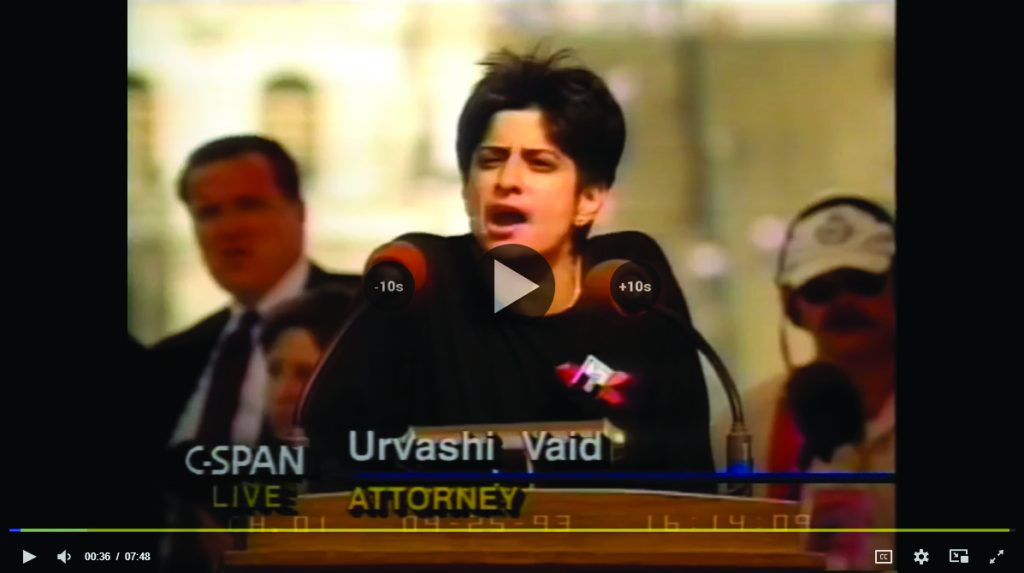
1993 – The Task Force's Urvashi Vaid is a featured speaker at the March on Washington (MOW): "We've got to march from Washington into action at home. I challenge every one of you, straight or gay, who can hear my voice, to join the national gay and lesbian movement. I challenge you to join NGLTF to fight the Right. We have got to match the power of the Christian supremacists, member for member, vote for vote, dollar for dollar."
1993 – The Creating Change Conference is held in Durham, N.C.
1992 – The Task Force develops the Fight the Right Project, and produces the Fight the Right Action Kit which has been used by thousands of activists and organizers to help combat anti-gay ballot initiatives proliferating throughout the country.
1992 – The Creating Change Conference is held in Los Angeles, Calif. The Boycott Colorado project — in response to the passage of Amendment 2 — is launched at this conference. (Colorado voters passed Amendment 2, though the U.S. Supreme Court ruled it unconstitutional in 1996.) The Task Force assists local activists in the defeat of anti-gay referendum Ballot Measure 9 in Oregon.
1992 – The Task Force leads demonstrations at the Republican National Convention in Houston, Texas, where Pat Buchanan has declared a culture war on gay and lesbian people.
1991 – The Task Force launches a national campaign against the Cracker Barrel restaurant chain for their homophobic policy stating that their "obviously" gay employees were "failing to comply with normal heterosexual values" and fired them. More than a decade after Cracker Barrel attempted to purge its system of gay employees by ordering unit managers to fire non-heterosexual workers — a decision it rescinded verbally at that time following negative media exposure but which it had never repudiated in writing, a majority resolution from shareholders requested a change, and at its winter 2002 shareholders meeting Cracker Barrel agreed to amend the equal-opportunity policy of its 466-unit Cracker Barrel Old Country Store chain to say it would not discriminate based on sexual orientation. Former NGLTF board member Lynn Cothren was leader of the fair employment campaign which was conducted primarily in the South.
1991 – The Task Force holds its first L.A. fundraising dinner, which was covered in the Los Angeles Times, the Advocate and the Hollywood Reporter. This dinner is believed to be the first major LGBT event where Hollywood celebrities lend their name and presence to a non-AIDS specific LGBT fundr-aising event.
1991 – The Task Force delivers the first briefing on people of color and AIDS to the Congressional Black Caucus.
1991 – The Creating Change Conference is held in Arlington, Va.
1990 – The Task Force leads the national hate crimes coalition from the early 1980s through the signing of the federal Hate Crimes Statistic Act.
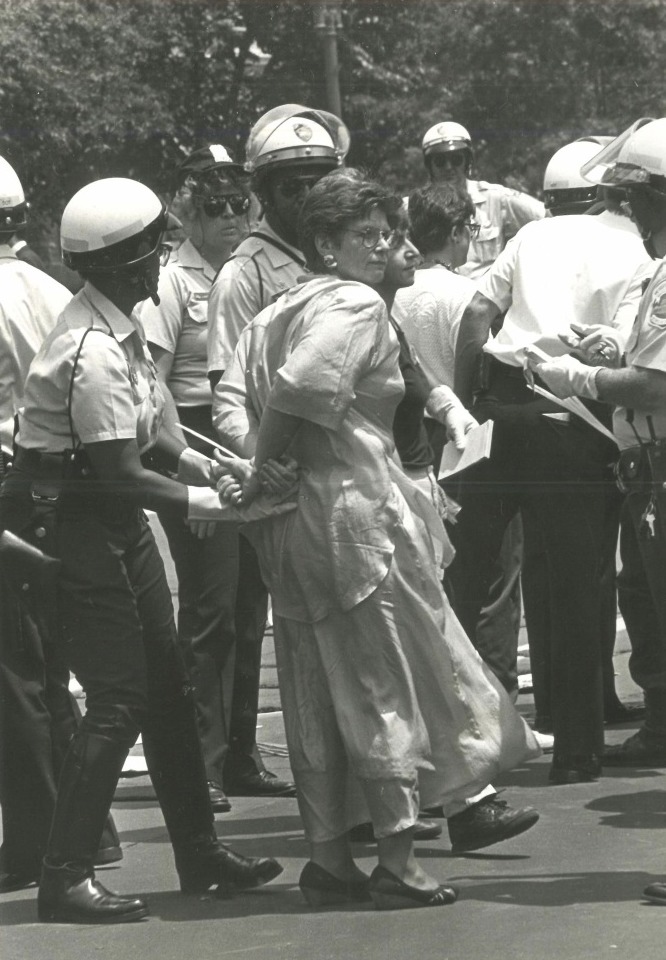
Then-Task Force Executive Director Urvashi Vaid interrupting President H.W. Bush's first and only AIDs policy speech at the National Community AIDS Partnership meeting on March 29, 1990.
1990 – The Americans with Disabilities Act is signed into law, with the Task Force lobbying heavily for persons with HIV/AIDS to be included.
1990 – The Task Force's Urvashi Vaid interrupts President Bush's first and only AIDS policy speech at the National Community AIDS Partnership meeting, holding a sign reading "Remember Gay People With AIDS."
1990 – The Creating Change Conference is held in Minneapolis, Minn. This is the first Creating Change to be held outside D.C. area, and the first to utilize a local host committee.
1980s
1980 – The Task Force founds the Fund for Human Dignity, a non-profit educational arm of the organization and hires a lobbyist, establishing a Task Force presence in Washington D.C. for the first time.
1982 – Virginia Apuzzo, executive director: "As our movement grows larger, the traditional pursuit of access and visibility are no longer enough. We need to move from access to responsiveness and from visibility to full participation. We must not just think, but do."
1982 – Jeff Levi is hired as the Task Force's first lobbyist, and the first anywhere to specifically focus on AIDS issues. (In 1981, the Centers for Disease Control reports in its Morbidity and Mortality Weekly Report on June 5 about five men with rare form of pneumonia, Pneumocystis carinii. On July 3, CDC issues a second advisory on Kaposi's sarcoma, 20 cases in New York, six in California.) GRID (Gay-Related Immune Deficiency) which implies it is restricted to gay men, is changed to AIDS (Acquired Immune Deficiency Syndrome) at the adamant urging of Bruce Voeller in a meeting with CDC officials and as dramatized in the movie And the Band Played On. Death toll is at more than 200. Response to AIDS still slow from mainstream media, even by end of year with more than 300 dead and 800 infected. AIDS makes the front page for the first time in a Los Angeles Times story May 31, "Mysterious Fever Now an Epidemic." First network mention is on NBC in June, Tom Brokaw: "CDC study shows that the lifestyle of some male homosexuals has triggered an epidemic of a rare form of cancer."
1982 – The Task Force launches the first national project to combat anti-gay violence and establishes the first national crisis hotline. The Anti-Violence Project provided technical assistance to local groups, coordinated the first national surveys of hate-based homophobic violence and worked to bring that violence to the attention of the Justice Department.
1983 – Researchers discover the virus (Human Immunodeficiency Virus or HIV) that causes AIDS. The Task Force , in coalition with other gay organizations, raises money and helps launch AIDS Action and the NORA (National Organizations Responding to AIDS) coalition.

1984 – The Task Force issues the first comprehensive report of anti-gay violence and victimization. The Task Force Anti-Violence Project, headed by Kevin Berrill, is one of the most significant projects in the history of the LGBT movement.
1984 – The Task Force obtains the first funding by the federal government for community-based AIDS service organizations.
1985 – To make clear the commitment to gender parity and lesbian issues, the Task Force changes its name to the National Gay and Lesbian Task Force.
Mid-1980s – From Interpreting the NGLTF Story: " By the mid-'80s, NGLTF made a conscious effort to keep both insider and outsider approaches to change in balance, so that both were in the Task Force tool kit of advocacy methods. Thus, NGLTF was willing to negotiate with the FDA over its approach to testing and approving AIDS drugs at the same time it was actively supporting militant ACT UP demonstrations against the FDA."
1985 – Jeff Levi, executive director: "For several years we have pressed the federal government to respond to the violence [against LGBT people] yet the actual response has been denial and neglect."
1985 – The Task Force's main offices move to D.C. in response to the increasing emphasis of work at the federal level.
1985 – The Task Force , in NGLTF v. Oklahoma, wins the overturn of a law that prohibited gay teachers from discussing gay rights.
1986 – LGBT History: In Bowers v. Hardwick, the Supreme Court rules that the Constitution allows states to pass and enforce sodomy laws targeting homosexuals. This resulted in the first LGBT Washington D.C. demonstration (in October 1987) and the largest demonstration (estimated at 5,000 people with an estimated 700 arrested) against the U.S. Supreme Court.
1986 – The Task Force convenes groups working on sodomy repeal at the annual Southeastern Gay and Lesbian Conference in Atlanta, marking the beginnings of the Task Force's Privacy Project.
1987 – The Task Force sodomy/pride tour of southern states visits 10 cities during pride season to promote work on sodomy laws.
1987 – The Task Force was part of the March on Washington steering committee, and was represented by various staff members from the very beginning through the event itself. Urvashi Vaid served as the media coordinator for the march, and organized the first in a series of town hall meetings organized under the Task Force's Privacy Project, bringing an estimated 500 attendees. The Task Force produced a resource guide of action packets for activists to take home and gave away hundreds of signs regarding state sodomy laws for the march, with the tagline "never another jailed for love."
Then-Task Force Media Director Urvashi Vaid and then Privacy Project Director Sue Hyde at the 1987 National March on Washington for lesbian and gay rights.
1988 – LGBT History: October, ACT UP stages a wild civil disobedience action "die-in" in the street in front of FDA headquarters in Rockville, Md. More than 1,000 people participate in the nine-hour protest; 176 are arrested. The Task Force's Sue Hyde is chair of the action committee.
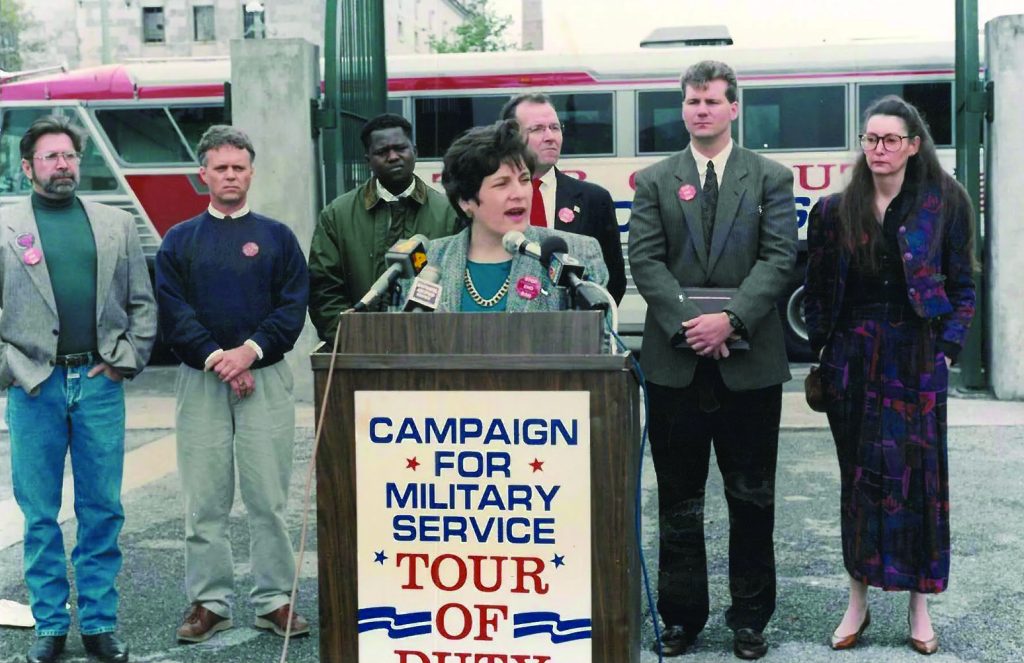
1988 – The Task Force convenes Military Freedom Project, to overturn the ban on military service for gays and lesbians and to campaign for military freedom for women's rights. The Task Force exposed instances of women being called "dykes" and "lesbos" for refusing to have sex with men.
1988 – The Task Force, in coalition with HRCF, ACT UP and others, brings AIDS issues to both major conventions in Atlanta (DNC) and New Orleans (RNC).
1988 – First of the annual the Creating Change conferences is born. Held in Washington, D.C., the conference will grow to an average of 2,000 activist participants from all over the country each year.
1989 – The Task Force launches the Families Project in conjunction with the National Center for Lesbian Rights.
1989 – Urvashi Vaid, executive director; Vaid's involvement with the Task Force began as a board member in 1985.
1989 – A National Day of Mourning is organized by the Task Force's Privacy Project to protest Bowers v. Hardwick on the occasion of the third anniversary of the decision.
1989 – The Creating Change Conference is held in Bethesda, Md.
1970s
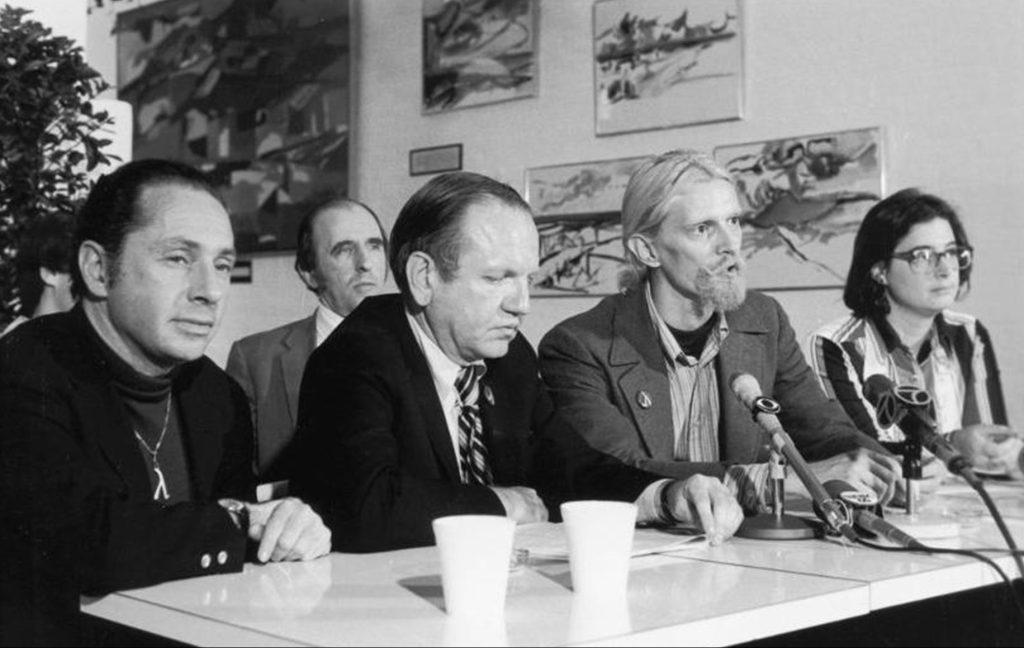
(L-R) Task Force co-founders Bruce Voeller, Frank Kameny and Howard Brown at a press conference announcing the founding of the Task Force in November 1973.
1973 – National Gay Task Force Foundation founded in New York.
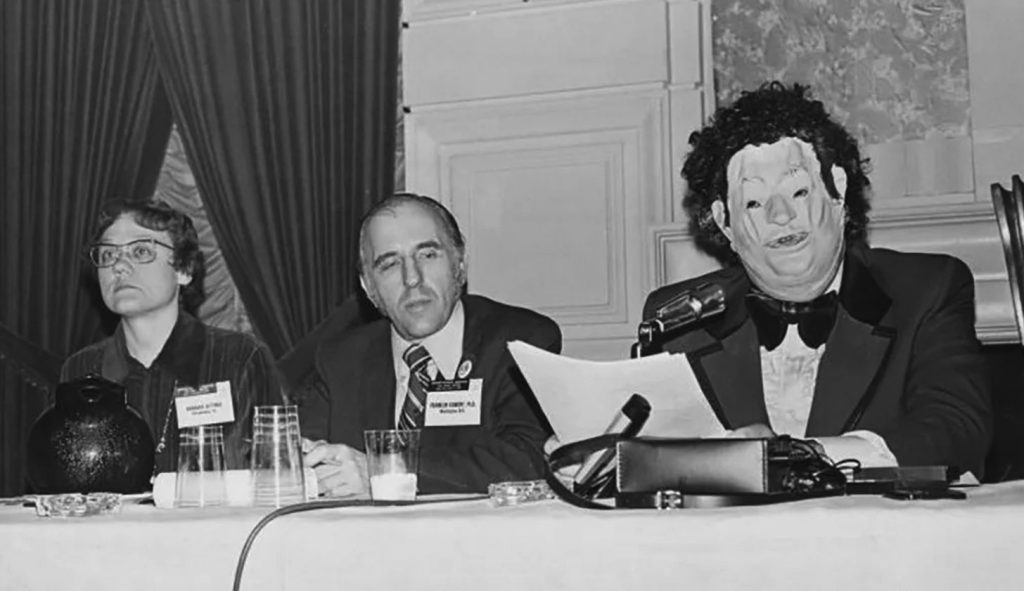
1973 – The Task Force works to change the American Psychiatric Association's classification of homosexuality as a mental disorder, and worked with psychiatrist allies to defeat a proposed association-wide referendum to stop the declassification.
1973 – The Task Force lobbies the American Bar Association to be on the record in favor of sodomy law repeal.
1974 –The National Gay Task Force, Inc., is founded and incorporated in New York as a separate 501(c)(4) tax-exempt organization. NGTF, Inc., is a "social welfare" organization legally authorized to engage in significant grassroots and direct lobbying to either help defeat anti-LGBT ballot initiatives and other measures or help push pro-LGBT legislation and other measures.
1975 – The Task Force lobbies for the successful ruling by the U.S. Civil Service Commission allowing gay people to serve in government employment.
1975 – The Task Force works on the introduction of the first gay rights bill in the U.S. Congress (HR5452), sponsored by Rep. Bella Abzug.
1975 – The Task Force secures a resolution from the National Council of Churches condemning anti-gay discrimination.
1975 – The Task Force coordinates one of the first national protests against the media in response to a homophobic episode of the television show Marcus Welby, M.D.
1975 – The Task Force wins a reversal of an IRS policy that denied tax exempt status to organizations that argued that homosexuality was acceptable.
1975 – The Task Force conducts the first national survey of major corporations to determine their hiring practices, then begins to advocate for nondiscrimination policies.
1976 – Bruce Voeller and Jean O'Leary, co-executive directors. "[The Task Force's purpose is] to re-educate society, including its homosexual members, to esteem gay men and women at their full human worth and to accord them places in society which will allow them to attain and contribute according to their full human and social potential." - Bruce Voeller, in the firstTask Force newsletter.
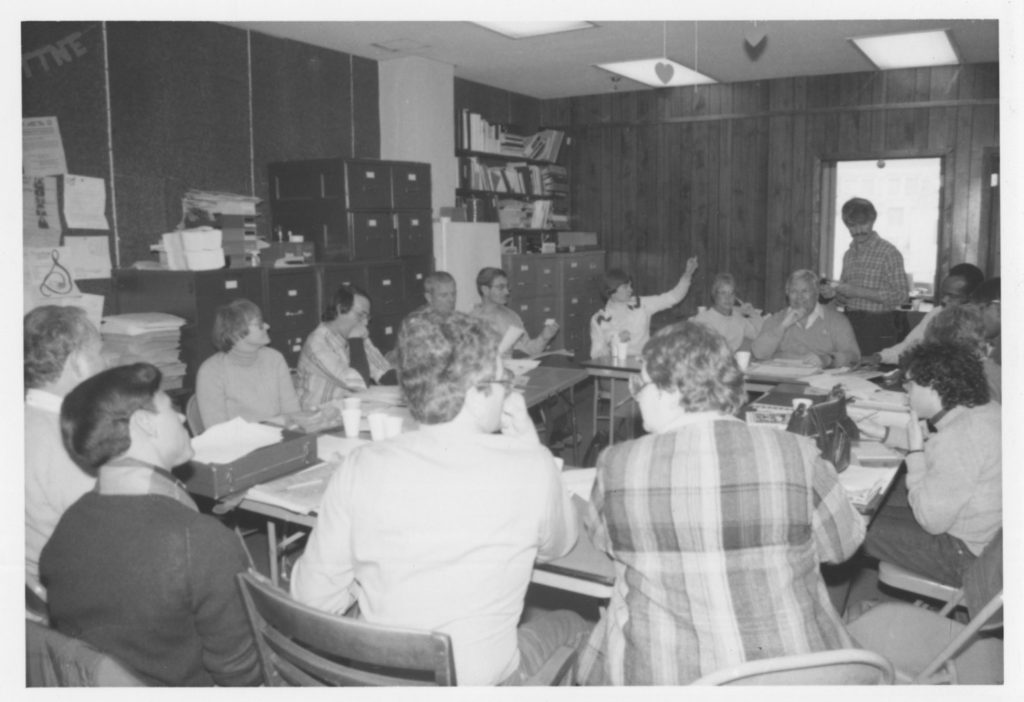
The Task Force staff and board in 1976.
1976 – The Task Force initiates Democratic National Convention project, surveying presidential candidates and organizing constituent meetings. NGTF gathered signatures from 600 delegates in support of gay rights and sodomy law repeal.
1977 – The Task Force launches national educational campaign in response to Anita Bryant's anti-gay campaign to repeal gay rights ordinances across the country.
1977 – Task Force Executive Director Jean O' Leary is appointed to President Carter's International Women's Year Commission and coordinated the passage of sexual preference resolutions at 30 state conferences and the national conference in Houston — a milestone in making equality for lesbians a key feature of mainstream feminist advocacy.
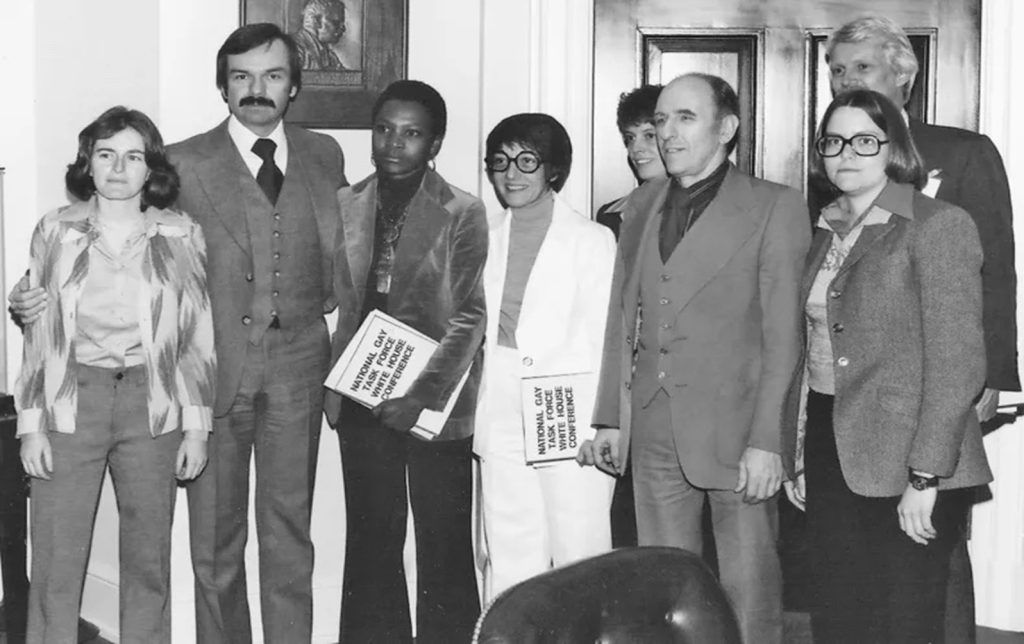
March 26, 1977 — The Task Force arranges with President Jimmy Carter’s assistant Midge Costanza for a historic first White House meeting with representatives of several gay and lesbian organizations. This is the first time in our nation’s history openly gay and lesbian are welcomed at the White House and the first official discussion of gay and lesbian rights in the White House. In addition to Task Force Co-Executive Directors Bruce Voeller and Jean O’Leary, leaders at the meeting include Pokey Anderson, Charles Brydon, Charlotte Bunch, Frank Kameny, Cookie Lutkefedder, Mary Mendola, Elaine Noble, Rev. Troy Perry, Betty Powell, George Raya, Myra Riddell and Charlotte Spitzer.
1978 – The Task Force releases the first-ever study of private sector workplace discrimination based on sexual orientation.
1978 – The Task Force successfully lobbied the U.S. Public Health Service to stop certifying gay immigrants as "psychopathic personalities."
1979 – Charles Brydon and Lucia Valeska, Task Force co- executive directors.
1979 – The Task Force co-sponsors the first national conference of third-world gays and lesbians, which spurred autonomous organizing in the 1980s within people of color communities.
NOTE: This list is not all-inclusive of every project the National Gay and Lesbian Task Force has worked on over the last three decades. It is meant to be a way to flesh out major accomplishments throughout the years. If you feel a major milestone has been inadvertently omitted, please e-mail dates and relevant information to media@theTaskForce.org