Creating Change 2027 Proposals
Caucuses are and will remain an important part of the conference agenda. This year, the Task Force will be reaching out proactively to caucus conveners to host these community-building spaces.
Workshop Proposal Guidelines
Deadline for proposal submissions: September 15, 2026
Notifications delivered beginning: November 2026
About Creating Change:
The National LGBTQ Task Force’s annual Creating Change convening is the nation’s foremost political, leadership, and skills-building event for the LGBTQ+ movement. Through Creating Change and other advocacy programs, the Task Force is pushing back against a continued wave of anti-LGBTQ+ attacks in local communities, states, and across the nation. As the Task Force prepares for its 39th Creating Change convening, we know our movement is unstoppable.
In This Guide:
- GENERAL INFORMATION
- Submission Deadline
- Registration Fees, Travel, and Lodging
- Workshop Scheduling
- No Solicitation
- Caucuses
- Interpretation, Translation, and Language Access
- Proposal Review and Notification
- WORKSHOP PROPOSALS
- Workshop Format
- Content Priorities
- Collaboration Is Key: Presenter Priorities
- Workshop Title
- Workshop Description
- Tracks & Session Categorization
- Primary Tracks
- Skill & Sector Tracks
- Demographic Focus
- Open / Closed Sessions
- Intersectional Lens
- Learning Objectives, Participant Engagement, & Skill Level
- Workshop Focus
- Prior Presentations
- Additional Speaker(s)
- Presenter Demographics
To submit a workshop proposal, please read this completely. It contains critical instructions and information.
General Information
IMPORTANT: Submission Deadline
Proposals received by 11:59 pm Pacific Time on September 15, 2026, will be reviewed and considered for scheduling. The deadline will not be extended. The Task Force reserves the right to decline proposals received after this deadline.
Registration Fees, Travel, and Lodging
Registration fees help cover about one-fifth of the cost of producing Creating Change and support the organization’s ongoing work. Thank you for making the investment with us!
All presenters whose proposals are accepted for scheduling will receive a link to register at a discounted presenter rate. For safety and security reasons, only registered attendees are able to access Creating Change event spaces.
All presenters must register for Creating Change.
If your proposal is not accepted at this time, you will receive a registration discount in gratitude for the time you invested in your submission. This rate will be equivalent to the Kick-Off registration rate.
Presenters are responsible for the cost of registration, travel, and lodging.
Workshop Scheduling
Programming will begin on Wednesday, January 27 and conclude on Sunday, January 31, 2027.
Workshops will be scheduled from 9:00 AM Thursday, January 28 through Saturday, January 30, 2027.
Presenters are expected to plan travel and lodging according to these dates above.
Session scheduling requests cannot be accommodated.
No Solicitation
Proposals that primarily promote or sell commercial products – and/or that promote or sell the commercial work of individual people – will be declined.
Caucuses
Caucuses are and will remain an important part of the programming agenda. This year, the Task Force will be reaching out proactively to caucus conveners to host these community-building spaces. Please do not use the workshop proposal form to propose caucus spaces.
Interpretation, Translation, and Language Access
Creating Change prioritizes accessibility to include the provision of American Sign Language (ASL) and Spanish/English interpretation in workshops and caucuses. Interpreters work hard to help build an accessible conference, relying on meaningful preparation to optimize the services they provide.
Accepted presenters are responsible for submitting session materials (outlines, handouts, slide decks, etc.) by Tuesday, December 1, 2026, according to a process set by Creating Change staff. Accepted presenters will receive information about providing this information.
If materials are not received by this deadline, your session may be canceled at the discretion of the Task Force. By submitting a proposal, you understand and agree to these terms.
Language access is for everyone. Thank you for joining us in this important commitment.
Proposal Review and Notification
Teams of Task Force staff and outside experts will review all proposals. Proposals are evaluated based on depth of content, plan for interactivity, demonstrated qualifications and experience, and whether there is an expressed commitment to representation and inclusion across race, gender, class, age, and disability. Each year, proposal submissions exceed what can be accommodated in the conference schedule, and only about one quarter of submissions can be approved.
In cases where we receive multiple strong submissions for similar topics, we may ask you to combine your session with another proposer.
Notifications regarding the status of proposals will be delivered via email beginning on or after November 2, 2026.
Workshop Proposals
Workshop Format
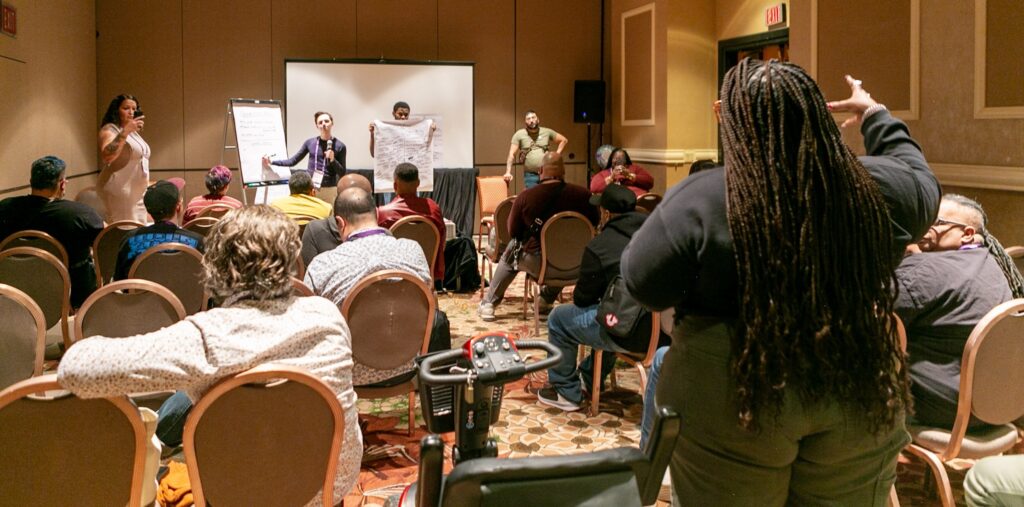
Workshops are 75 minutes and must feature opportunities to build skills and knowledge, emphasizing participant engagement and interactivity. When submitting your proposal, please be mindful of what can be effectively communicated in the time allotted.
Content Priorities
The Task Force has a strategic focus on the pillars of democracy, economy, and care. Sessions at Creating Change reflect these strategic pillars and include movement-building, grassroots organizing, leadership development, capacity-building, and educational opportunities for both new and seasoned activists, advocates, and leaders. Our current social and political climate also requires an explicit commitment to the Task Force’s values of racial, economic, gender, and disability justice.
Therefore, the Task Force prioritizes proposals that:
- Center Trans, Black, and/or Indigenous people and communities.
- Demonstrate a deep analysis of the intersections between LGBTQ+ issues and other movements for social justice, including reproductive freedom, environmental justice, immigration, and education/access to information.
Collaboration Is Key: Presenter Priorities
We prioritize sessions that involve multiple organizations and/or subject matter experts. Sessions focused on or utilizing individual case studies or one individual’s expertise may be accepted; proposals that include multiple case studies or examples may be stronger submissions. Consider proactively reaching out to other subject matter experts in your field to combine your efforts and submit one joint workshop proposal.
Examples:
- Representatives of organizations in a regional coalition working on a ballot measure campaign
- Comparative case studies of organizations implementing deep canvassing initiatives in their communities
- Panel on sex work decriminalization that includes panelists with lived experience, professional policy experts, and community organizers
All presenters should have demonstrated credibility and expertise in the subject areas relevant to the proposed session. Expertise and credibility may include lived experience and/or professional expertise and experience.
While you are welcome to submit multiple proposals, the Creating Change team works to ensure we have a wide variety of presenters and perspectives in our workshops. To that end, we may limit the number of proposals accepted from a single presenter.
Workshop Title
The best titles:
- Are eye-catching AND precise, descriptive, and clear
- Avoid excessive jargon
- A few examples of great titles:
- Media Relations Skills for Trans Justice
- Active Bystander Skills for Dangerous Times
- Using Political Education As A Tool To Fight Fascism
- Growing Individual Giving in a Politically Charged Climate
- Examples of not great titles (vague, unclear):
- Breaking the Silence and Lifting our Voices
- Empowering Invisible Communities
- Reclaim Power for Us
Workshop Description
The best workshop descriptions provide an urgency statement (why this matters now) and a clear explanation of what attendees can expect from your session. Descriptions must be brief – under 75 words.
The best workshop descriptions:
- Are written with clarity and brevity
- Use clear language
- Include both “what” and “why”
- Give a brief (appx 1-2 sentences) overview of what attendees can expect to learn/experience in your session
- Example of a great workshop description (from a CC2026 workshop):
- In today’s climate of escalating anti-LGBTQ+ legislation and hostility, fundraising is more than a financial necessity‚ it is an act of movement building. This 75-minute interactive workshop will highlight why individual giving is critical to sustaining advocacy and protecting LGBTQ+ communities. Participants will gain practical tools to strengthen their case for support, leverage personal and professional networks, and use storytelling to inspire donors. Designed for both beginner and experienced fundraisers, the session combines strategy with action. Attendees will map their own donor networks, practice engagement techniques, and leave with an action plan for increasing individual giving. The workshop also explores how private and public funding opportunities complement grassroots support, ensuring participants walk away with both inspiration and concrete resources to fuel the fight for equality.
Tracks & Session Categorization
To keep the Creating Change schedule clear and balanced, and to ensure each proposal is reviewed by the right subject-matter experts, every workshop must align with one to two Primary Tracks, as well as one to three more specific Skill & Sector Tracks.
You will also tag up to three items in each of these sub-fields: Demographic Focus, and Intersectional Lens. These tags help reviewers compare like with like and help participants quickly find sessions that meet their needs.
Notice: Software limitations prevent us from capping selections. DO NOT select more options than stated in each section. Selecting beyond your workshop’s core focus prevents the review team from proper review and attendees from finding aligned sessions.
Primary Tracks
The Task Force has identified three primary strategic priorities or pillars to serve as the primary tracks for our 2027 Creating Change workshops: Democracy, Economy, and Care.
Our working definitions and intentions for these tracks, along with example workshop topics that may fall within these tracks, are below.
Democracy
The Democracy pillar ensures LGBTQ+ communities have the power to protect themselves, influence decisions, and hold institutions accountable. By strengthening political safety, representation, and collective voice, this pillar supports dignity, self-determination, and the ability to transform systems that govern our lives.
Sessions in this track will offer in-depth conversations to build the necessary political power and social momentum to meet our current moment. Sessions will create space for strategizing and creative exploration to push forward an equitable and intersectional democracy. Skills and knowledge gained in this track will emphasize lessons for building effective coalitions, defending against legislative attacks, and advancing a people-powered, pro-LGBTQ+ agenda at the ballot box and in local government and state houses.
Examples of workshop topics in the Democracy track: voting rights & fair elections, political safety, countering authoritarianism, organizing against ICE raids, ballot measure and electoral campaigns, strategies and tactics for making policy changes
Economy
The Economy pillar ensures LGBTQ+ people have the material foundation to live – not just survive – through stable income, safe housing, and protection from exploitation. By meeting basic physiological and safety needs, this pillar creates the conditions for people to participate in community life, access care, and build lasting power.
Sessions in this track will equip attendees with the knowledge, skills, strategies, and tactics to ensure that LGBTQ+ people have the material foundation to live not just survive, through stable income, safe housing, and protection from exploitation. This programming offers an intersectional lens on topics that relate to that material foundation.
Examples of workshop topics in the Economy track: LGBTQ+ labor justice, food security, housing stability, worker justice, decriminalization of sex work
Care
The Care pillar ensures LGBTQ+ people have bodily autonomy, access to affirming care, and community support, allowing them to live with dignity, health, and connection. By meeting physical, emotional, and social needs, this pillar makes it possible for people to belong, to heal, and to show up fully in both private and public life.
Sessions in this track will focus on equipping attendees with the knowledge, skills, strategies, and opportunities for action for building our movement’s capacity in community care, healing, resilience and resistance, physical/emotional/psychological safety, and implementing the principle of bodily autonomy.
Examples of workshop topics in the Care track: mental health access, trauma-informed leadership & organizational development, culturally responsive & affirming healthcare access, building belonging and resilience, community & individual safety
Skill & Sector Tracks
As part of your workshop submission, you will be asked to select between one and three skills and/or sectors that your curriculum falls into.
Please do not select more than three.
- Activism & Direct Action
- Arts & Culture
- Board Service
- Campaign Organizing & Strategy
- Civic Engagement
- Safety & Security
- Communications, Marketing, & Branding
- Community Care
- Data & Research
- Direct Service
- Executive Leadership
- Faith & Spirituality
- Health and Wellness
- Lobbying & Legal Advocacy
- Organizational Development
- Personal Development
- Philanthropy & Fundraising
- Sexual Healing and Liberation
Demographic Focus
You will also be asked to select between one and three descriptions of the community demographic your workshop is intended to be about. Your workshop may not be about a particular or specific community demographic; if so, please only select ‘applicable to all.’
For example, if your workshop is about services for youth of color, you may select “youth & students” and “people of color.”
Please select 1-3 options of the community and/or demographic focus of your workshop.
- Applicable to All
- AANHPI
- Asexual, Aromantic
- Aging and Elders
- Black
- Bi+
- Gay
- Indigenous & Two-Spirit
- Intersex
- Latine
- Lesbian
- People Living with HIV
- People of Color
- People with Disabilities
- Trans & Nonbinary
- Youth & Students
Open / Closed Sessions
The vast majority of sessions at Creating Change are open to all attendees, but we may accept a few sessions that are intended to be closed, i.e. only open to specific audiences. For example, a select few sessions may be limited to youth, BIPOC attendees, attendees who serve as Executive Directors/CEOs, trans and/or nonbinary attendees, etc.
In the proposal form, you will be asked to note whether your session is open or closed.
- If your session is open to all, please mark your session as “open.”
- If your session is intended primarily for a certain audience but is still open to other attendees, please mark your session as “open.”
- If your session is intended to be open only for a certain audience and others should not attend, please mark your session as “closed,” and specify the audience on the form.
Intersectional Lens
Finally, you will be asked which of the following intersectional justice lenses apply to the core of your workshop.
Many workshop proposals, like much of our movement work, may sit at multiple intersections. In order to direct proposals to the most appropriate reviewers, you will be asked to select at least one and no more than two intersectional lenses your workshop will primarily utilize and are most central to your workshop.
- Class/Economic Justice
- Disability Justice
- Environmental Justice
- Immigration/Refugee Justice
- Racial Justice
- Reproductive Justice
- Sex/Gender Justice
- SOGI/LGBTQ Justice
- Spiritual Justice
Learning Objectives, Participant Engagement, & Skill Level
Workshop proposals are reviewed for emphasis on engagement and practice. On the submission form, you will be asked to respond to the following prompts. Please keep your answers relatively brief; you’ll have a maximum of 1,500 characters for each answer.
Learning Objectives:
- What will participants know, feel, believe, or be able to do after your session?
If you’ve included your learning objectives in your workshop description (what attendees can expect to learn/experience in your session), please expand on that here. Be mindful of the workshop length (75 minutes) and skill level; no single workshop is likely to turn someone into an expert! Be realistic in defining the learning objectives for your attendees.
Participant Engagement:
- What interactive strategies will you employ to actively engage participants and meet the objectives of your workshop?
The best workshop proposals have fully formed and clear explanations of their interactive elements. An understanding of how adults learn and engage, and a firm grasp of interactive facilitation tools and skills, are important elements of a successful workshop proposal. Consider utilizinginteractive elements that are well-tailored to the content and objectives of your workshop.
The Creating Change team will also support accepted speakers with interactive elements and workshop design and flow by hosting Workshop Presenter Skill-Share virtual sessions prior to CC27, where presenters will be able to share and discuss their facilitation skills and tools with one another and draw on each other’s experience and expertise.
Skill Level:
- Is your session advanced or applicable to all?
Creating Change attendees represent a wide variety of our community, from first-timers to decades-long returning attendees of this conference, and from newly out or new-to-the-movement activists to veterans of the movement who have been organizing for 50+ years. Consider this wide range of experience when determining the skill level of your workshop.
Workshop Focus
Your workshop may include all four of these, but you’ll be asked to select the option that your workshop most focuses on. You’ll be asked to select no more than two.
- Skills
- These sessions focus on teaching practical skills to attendees.
- Examples: deep canvassing, developing messaging guidelines, active bystander, power-mapping, digital safety & security
- Knowledge
- These sessions focus on sharing up-to-date data, research, and information.
- Examples: findings from recent reports or surveys, current messaging tactics, learnings from successful or unsuccessful campaigns/projects, historical arcs, understanding evidence-based models for building movement capacity
- Action Lab
- These active sessions include taking concrete action; this may be an opportunity to practice a specific tactic or skill, or part of a longer-term action or advocacy plan.
- Examples: letter-writing campaign, GOTV postcards, text-banking, power-mapping your community, creating a communal art piece
- Strategy Lab
- These deeply collaborative sessions act as incubators to develop strategy for our movements.
- Examples: narrative shift feedback and strategy building, state policy strategy share, priority-setting strategies for specific communities
Prior Presentations
These two questions will ask a) how many times you have presented this workshop at Creating Change, and b) how many times you have presented this workshop in any other spaces. We ask this question to ensure that we are balancing the need for new, innovative sessions from new speakers with the ongoing need for core competencies for the movement. Our subject-matter-expert reviewers will take these answers into consideration along with the whole of your proposal.
Additional Speaker(s)
Please add all confirmed or intended speakers for your proposed workshop to your proposal. If accepted, you will be able to update this list through the speaker portal of our event software and/or inform the Creating Change team of any speaker changes; having a full and accurate list of all speakers in each session is important so that we can avoid double-booking any speakers.
You’ll be required to provide the following information about each presenter:
- Full name
- Cell Phone Number
Optional fields will include:
- Pronouns
- Organization
- Role/Title
Presenter Demographics
Providing demographics on the speaker(s) for your workshop is optional. This data is aggregated and used for internal reporting and tracking purposes as we ensure that Creating Change is an LGBTQ+ movement space that reflects our community. This data is not part of the proposal review process.
If you are proposing a workshop with multiple speakers, please confirm these demographic answers with your fellow speakers prior to submitting your workshop form.
Demographic questions will include:
- Number of Presenters
- Number of BIPOC Presenters
- Number of Trans & Nonbinary Presenters
- Number of Presenters under 25
- Number of Presenters over 40
- Number of Presenters with Disabilities
- Number of Neurodivergent Presenters
Thank you for reading!
You are ready to apply to host a workshop at Creating Change! Thank you for reading! You are ready to apply to host a workshop at Creating Change!